
Panhala Fort
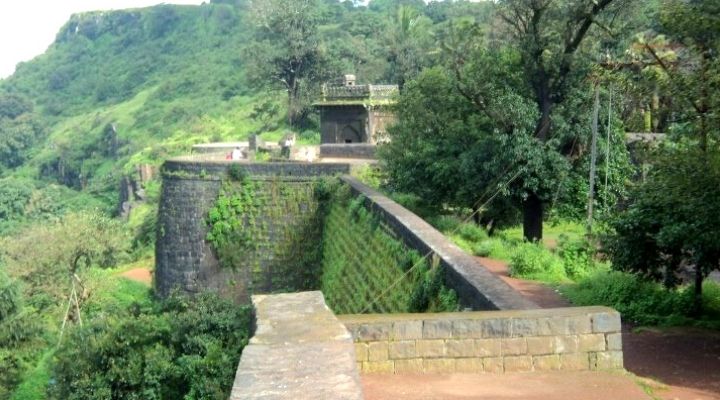
Panahala fort was built between 1178 and 1209 CE, one of 15 forts (others including Bavda, Bhudargad, Satara, and Vishalgad) built by the Shilahara ruler Bhoja II. It is said that aphorism Kahaan Raja Bhoj, kahan Gangu Teli is associated with this fort. A copper plate found in Satara shows that Raja Bhoja held court at Panhala from 1191–1192 CE. About 1209–10, Bhoja Raja was defeated by Singhana (1209–1247), the most powerful of the Devgiri Yadavas, and the fort subsequently passed into the hands of the Yadavas. Apparently it was not well looked after and it passed through several local chiefs. In 1376 inscriptions record the settlement of Nabhapur to the south-east of the fort.[3] It was an outpost of the Bahamanis of Bidar. Mahmud Gawan, an influential prime minister, encamped here during the rainy season of 1469. On the establishment of the Adil Shahi dynasty of Bijapur in 1489, Panhala came under Bijapur and was fortified extensively. They built the strong ramparts and gateways of the fort which, according to tradition, took a hundred years to build. Numerous inscriptions in the fort refer to the reign of Ibrahim Adil Shah, probably Ibrahim I (1534–1557)
In 1659, after the death of the Bijapur general Afzal Khan, in the ensuing confusion Chhatrapati Shivaji Maharaj took Panhala from Bijapur.[5] In May 1660, to win back the fort from Chhatrapati Shivaji Maharaj, Adil Shah II (1656–1672) of Bijapur sent his army under the command of Siddi Johar to lay siege to Panhala. Shivaji Raje fought back and they could not take the fort. The siege continued for 5 months, at the end of which all provisions in the fort were exhausted and Shivaji Raje was on the verge of being captured. Under these circumstances, Shivaji Raje decided that escape was the only option. He gathered a small number of soldiers along with his trusted commander Veer Baji Prabhu Deshpande and, on 13 July 1660,[6] they escaped in the dead of night to flee to Vishalgad. Veer Baji Prabhu and a barber, veer Shiva Kashid, who looked like Shivaji Raje, kept the enemy engaged, giving them an impression that veer Shiva Kashid was actually Chhatrapati Shivaji Maharaj. In the ensuing battle (see Battle of Pavan Khind), almost three quarters of the one thousand strong force died, including Veer Baji Prabhu himself.[7][8] The fort went to Adil Shah. It was not until 1673 that Shivaji Raje could occupy it permanently.